Needs assessment
One of the key components of Navigation is understanding Whānau needs, and planning what support they need.
These two components do not operate in the same way as Activities. We'll start with a close look at the first Needs Assessment part.
Starting the first assessment
Navigate to the Primary or Lead Whānau member, and click on Hauora Assessments.
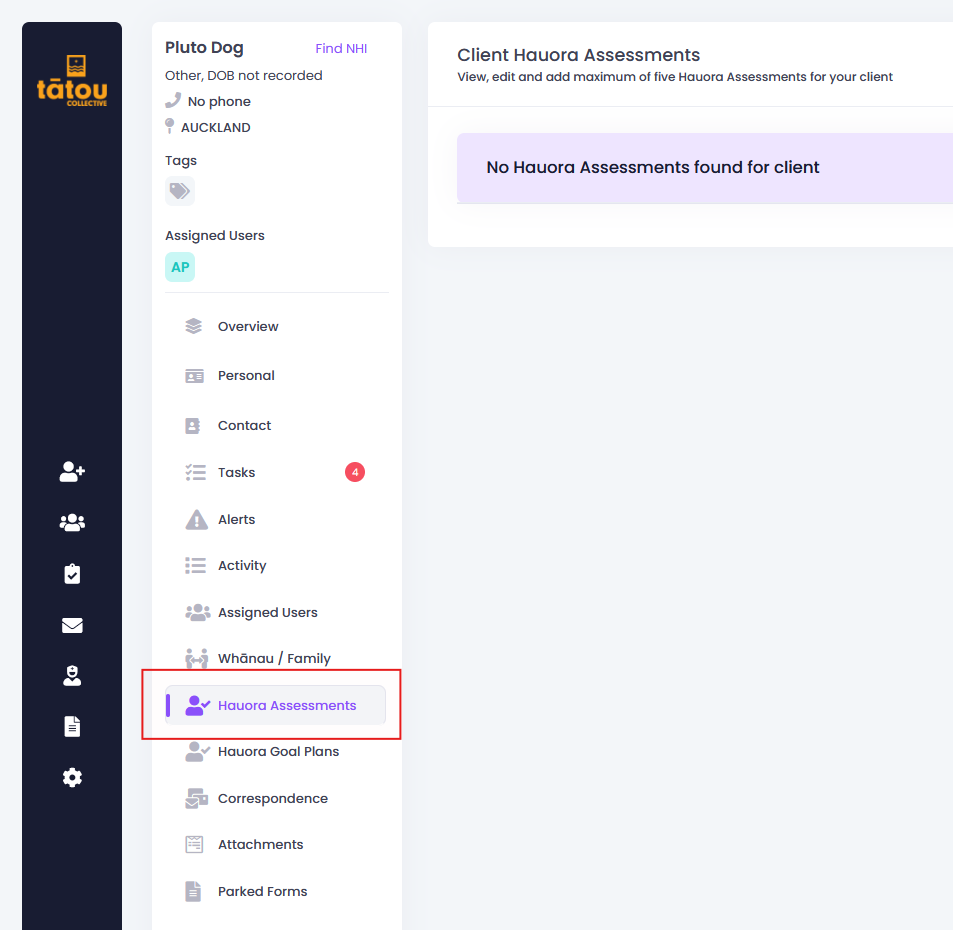
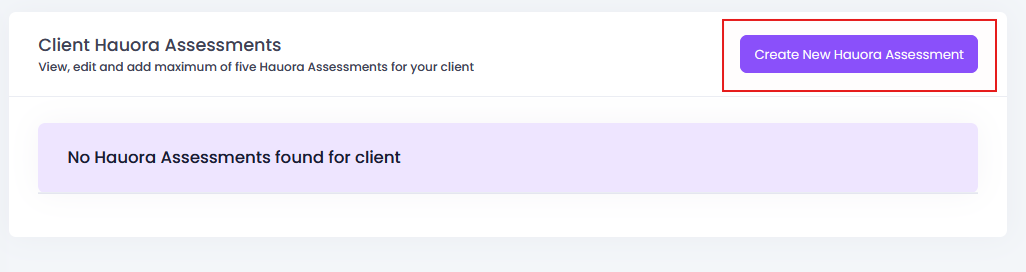
The screen will tell you "No Hauora Assessments found for client" which is obviously correct, so let's go ahead and click on Create New Hauora Assessment.
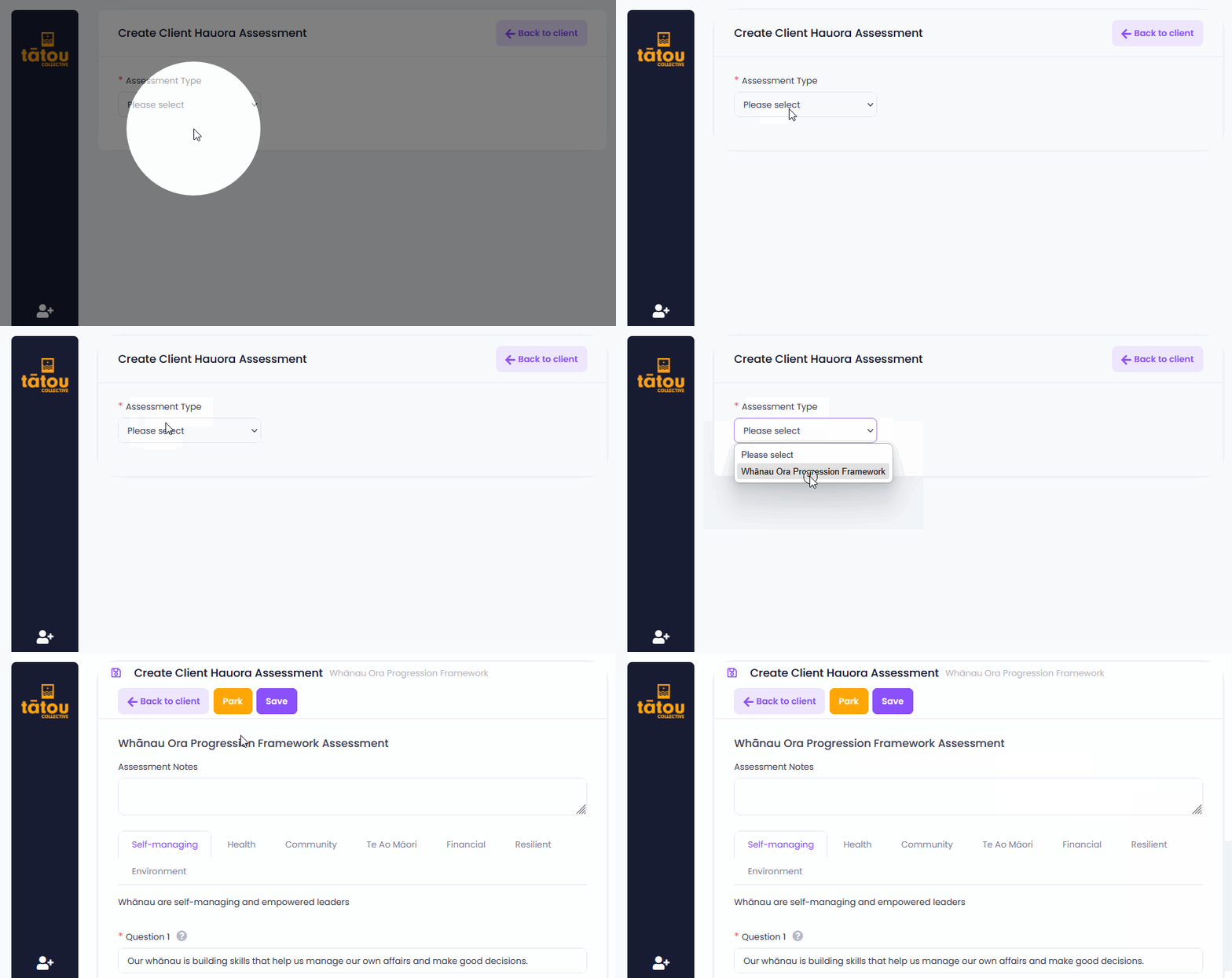
The next screen asks you to pick which 'Assessment Type' you want to complete. Existing Kotahi customers may have a range of options here, but otherwise just go ahead and click the 'Whānau Ora Progression Framework'.
Conducting your first assessment
What is the Progression Framework?
This is a key concept in this version of Whānau Ora. It provides a structured framework where we can measure the progress of Whānau against different parts of the overarching TPK Outcomes Framework.
This Assessment will give us a starting point to show where the Whānau is at. Subsequently we can see the positive change in the data.
It takes time to build trust and rapport with Whānau. We do ask that an initial Assessment is carried out in the early stages of a new case, but there is plenty of opportunity to add and develop it over time as your relationship deepens.
The Assessment follows a very predictable format:
For every Outcome Framework Domain, there are two Measures. For each Measure, there are two Questions.
Working through these questions should provide a clearer picture of Whānau needs.
| Outcome domain | Outcome indicator | Assessment question |
|---|---|---|
| Whānau are self-managing & empowered leaders | Self-managing whānau | Our whānau is building skills that help us manage our own affairs and make good decisions. |
| We take responsibility for planning and organising things that support our wellbeing. | ||
| Empowered Leaders | Members of our whānau are involved in supporting our wider community or groups we belong to. | |
| We feel confident to step into leadership roles and influence positive change around us. | ||
| Whānau are leading healthy lifestyles | Improving wellbeing | We take regular steps to support our physical, mental, spiritual, and whānau wellbeing. |
| Our whānau shares knowledge and ideas about how to live well and stay healthy. | ||
| Whānau Health | We believe we can manage our own health across all areas of wellbeing. | |
| Our whānau supports each other to access and use health services when needed. | ||
| Whānau are participating fully in society | Community Engagement | Our whānau is actively involved in schools, clubs, marae, or other community groups. |
| We contribute to and benefit from being connected to organisations in our community. | ||
| Whānau and community connectedness | We stay connected with our neighbours, wider whānau, and community. | |
| We have the tools and resources to maintain strong community relationships. | ||
| Whānau and families are confidently participating in Te Ao Māori (the Māori World) | Te Ao Māori | We feel connected to our whakapapa, culture, or Māori identity. |
| Our whānau participates in cultural practices and expresses our identity with pride. | ||
| Generational Connection | We make time to connect and share knowledge between younger and older generations. | |
| Our whānau relationships are strengthened by intergenerational support and learning. | ||
| Whānau and families are economically secure and successfully involved in wealth creation | Financial Security | We have the resources to meet our daily needs like housing, food, and clothing. |
| Our financial situation allows us to plan for the future with confidence. | ||
| Wealth Creation | Our whānau has savings or investments that support our long-term wellbeing. | |
| We are learning or taking steps to build and grow our financial resources. | ||
| Whānau are cohesive, resilient and nurturing | Safe and nurturing environments | Our home is a safe, stable, and welcoming place for all whānau members. |
| We create an environment that supports wellbeing now and for future generations. | ||
| Whānau Relationships | We have strong, respectful relationships within our whānau. | |
| We work together and support each other through challenges and successes. | ||
| Whānau and families are responsible stewards of their living and natural environments | Living Environment | Our whānau shapes our living space to meet our needs and support our wellbeing. |
| We take care of our home, whether owned, rented, or shared. | ||
| Te Taiao | Our whānau is involved in protecting or using the whenua (land) we connect with. | |
| We are learning about or practising ways to sustain the natural environment for future generations. |
The Assessment process in Kotahi is essentially to 'rank' where the Whānau is against each question.
Every question needs some kind of response. If you aren't ready to answer it yet, or the question is not relevant for this Whānau then just click 'N/A'!
If you start the Assessment and realise you aren't in a position to respond to every question yet, you can just Park it and come back later.
Progression scale
The actual 'ranking' process is done by selecting from a four point scale, as determined by TPK. For each question you can answer from one of the following options:
- Aspiring
- Growing
- Strengthening
- Thriving, or
- Not Applicable (N/a).
Naturally, we aim to move Whānau we are working with towards Thriving. In the Assessment tool itself, it is easy to pick from one of these options.
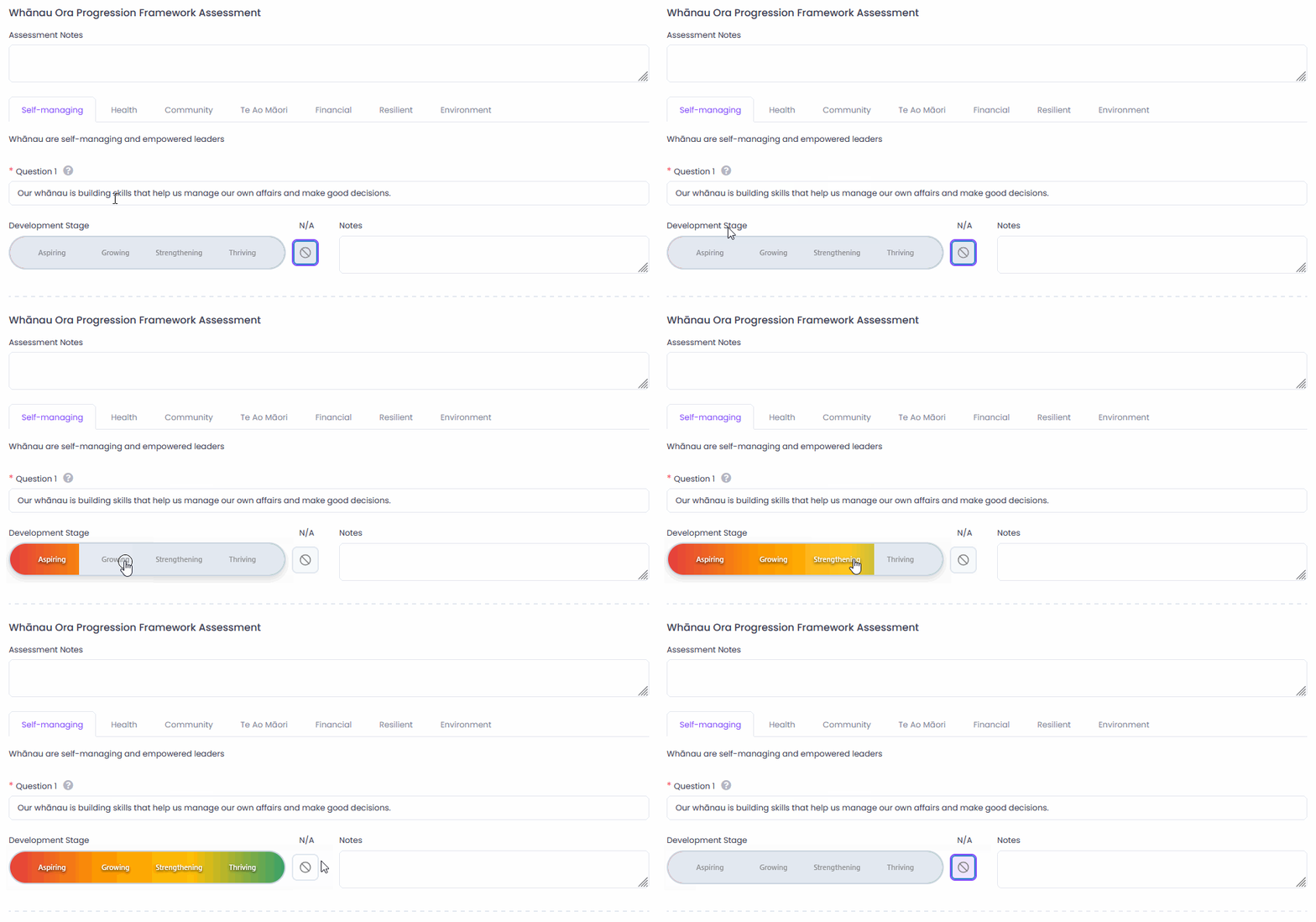
You can add some additional narrative for each question in the Notes box if you wish.
You must add a Summary note against each of the seven outcome domains before you can save the Assessment.
As already mentioned, feel free to Park your assessment and come back to it later.
When considering the Te Ao Māori domain, remember that we are mainly talking about Cultural Connectedness and Confidence.
Interpret these questions in a way that is most relevant for the Whānau you are working with.
Assessment results
After saving a completed assessment, you'll be taken back to the Overview screen. You'll now see a summary of your assessment, but it may not make much sense until you click View to see more info:
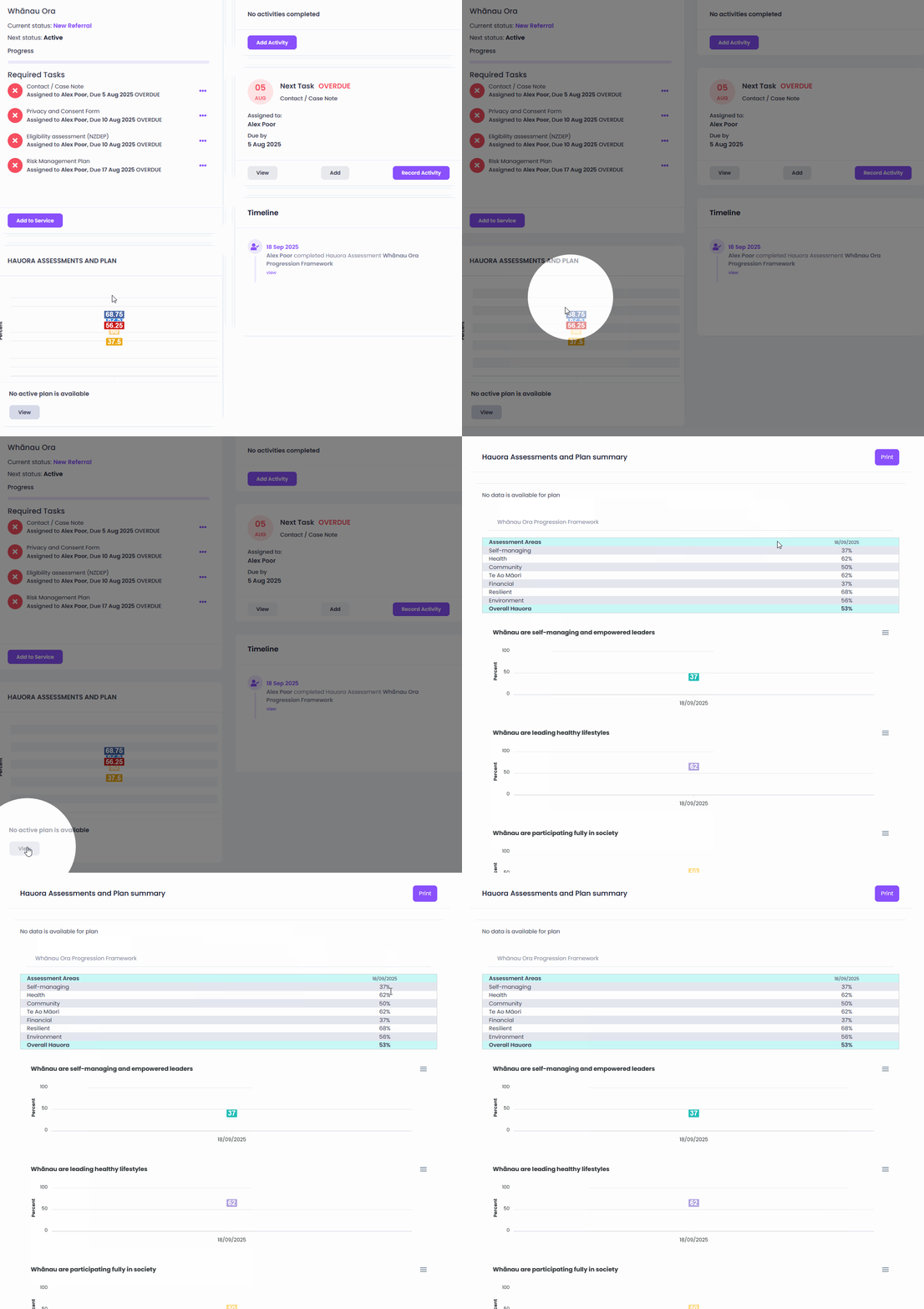
On this next screen you'll see the numeric summary of the Assessment. The seven Assessment Areas shown represent the Outcome Framework Domains, and a score is provided for each.
A lower score indicates the Whānau have more needs in this particular area, so it should be something that the Whānau Plan directly addresses.
On the graph you'll also see the date of your Assessment. As more Assessments are done over time, this picture will build up to show the Whānau progression journey!
Reassessment
You can come back and create a new Assessment at any time. The results of a new Assessment will be shown alongside previous ones.
In this example, we created a second Assessment and the change is clearly visible.
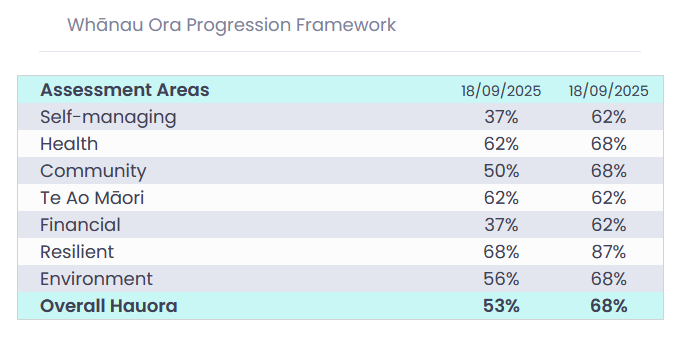
We can see that many areas have improved considerably.
This Assessment is tightly linked with the Whānau Plan - they should be considered as interconnected.